> ## Documentation Index
> Fetch the complete documentation index at: https://docs.wandb.ai/llms.txt
> Use this file to discover all available pages before exploring further.
# View and customize trace display
> View Calls in the UI and customize how trace data is displayed
After you create Calls in W\&B Weave, you often want to open a single call to inspect its inputs, outputs, and metadata. This page shows how to view a call in the UI or in the SDK, and how to customize how Weave renders trace data in the UI using `weave.Markdown`. Use the following tabs to choose the interface that fits your workflow.
To view a Call in the UI:
1. Navigate to [wandb.ai](https://wandb.ai/) and select your project.
2. In the Weave project sidebar, click **Traces**.
3. Find the Call you want to view in the table.
4. Click the Call to open its details page.
For details on the Trace view, see [Navigate the Weave Trace view](/weave/guides/tracking/trace-tree).
To view a call using the W\&B Weave Python SDK, use the [`get_call`](/weave/reference/python-sdk/trace/weave_client#method-get_call) method:
```python lines theme={null}
import weave
# Initialize the client
client = weave.init("your-project-name")
# Get a specific call by its ID
call = client.get_call("call-uuid-here")
print(call)
```
```typescript twoslash lines theme={null}
// @noErrors
import * as weave from 'weave'
// Initialize the client
const client = await weave.init('intro-example')
// Get a specific call by its ID
const call = await client.getCall('call-uuid-here')
console.log(call)
```
To view a call using the Service API, make a request to the [`/call/read`](https://docs.wandb.ai/weave/reference/service-api/calls/call-read) endpoint.
```bash theme={null}
curl -L 'https://trace.wandb.ai/call/read' \
-H 'Content-Type: application/json' \
-H 'Accept: application/json' \
-d '{
"project_id": "string",
"id": "string",
}'
```
## Customize rendered traces with `weave.Markdown`
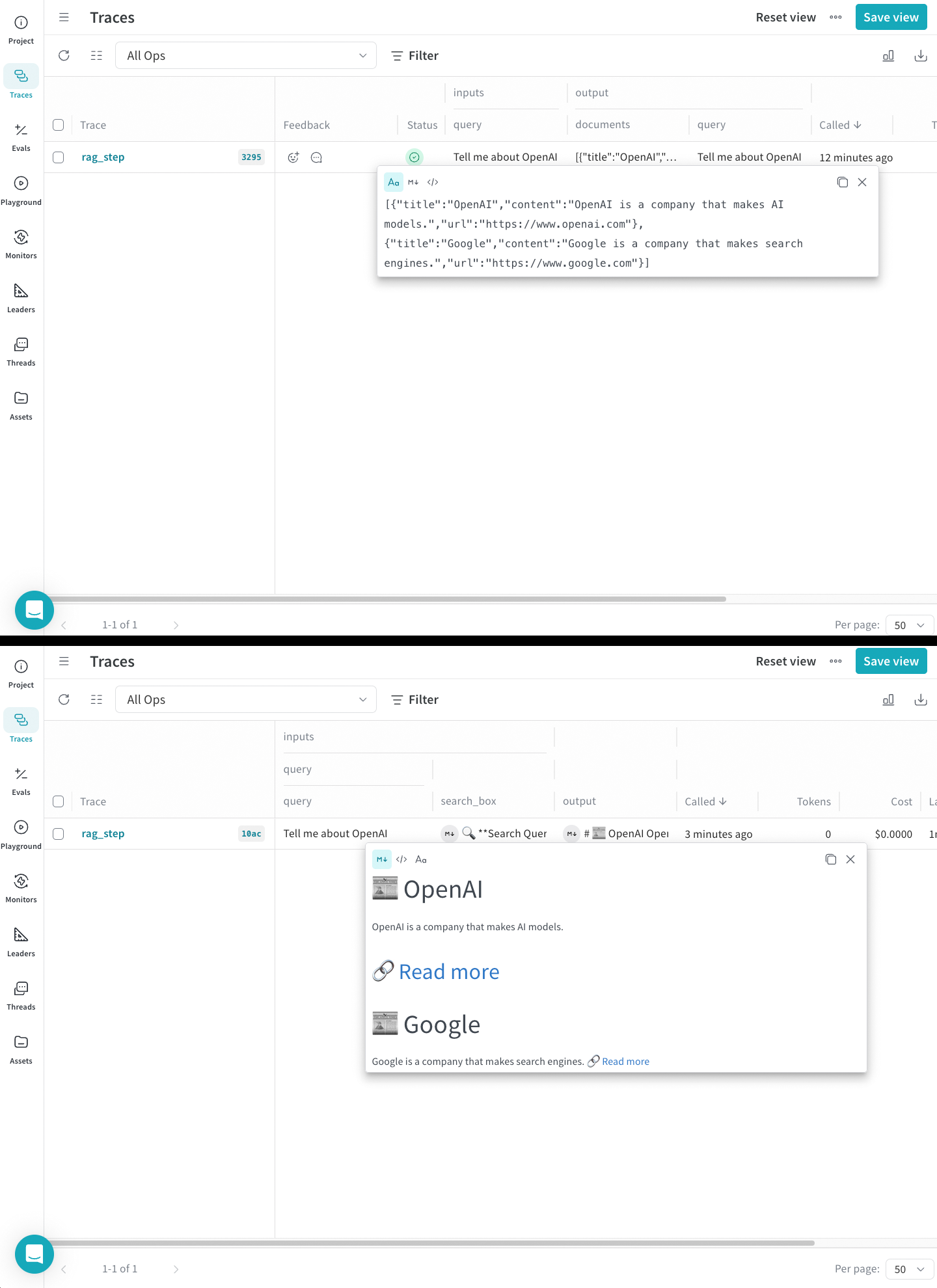
After you can view a Call, you may want to control how its inputs and outputs appear in the UI. Use `weave.Markdown` to customize how Weave displays your trace information without losing the original data. This lets you render your inputs and outputs as readable blocks of formatted content while preserving the underlying data structure.
Use `postprocess_inputs` and `postprocess_output` functions in your `@weave.op` decorator to format your trace data. The following code sample uses postprocessors to render a call in Weave with more readable formatting:
```python lines theme={null}
import weave
def postprocess_inputs(query) -> weave.Markdown:
search_box = f"""
**Search Query:**
``+`
{query}
``+`
"""
return {"search_box": weave.Markdown(search_box),
"query": query}
def postprocess_output(docs) -> weave.Markdown:
formatted_docs = f"""
# {docs[0]["title"]}
{docs[0]["content"]}
[Read more]({docs[0]["url"]})
---
# {docs[1]["title"]}
{docs[1]["content"]}
[Read more]({docs[1]["url"]})
"""
return weave.Markdown(formatted_docs)
@weave.op(
postprocess_inputs=postprocess_inputs,
postprocess_output=postprocess_output,
)
def rag_step(query):
# example newspaper articles of the companies on the S&P 500
docs = [
{
"title": "OpenAI",
"content": "OpenAI is a company that makes AI models.",
"url": "https://www.openai.com",
},
{
"title": "Google",
"content": "Google is a company that makes search engines.",
"url": "https://www.google.com",
},
]
return docs
if __name__ == "__main__":
weave.init('markdown_renderers')
rag_step("Tell me about OpenAI")
```
```plaintext theme={null}
This feature is not available in the TypeScript SDK yet.
```
After you run the op, Weave renders the formatted Markdown alongside the original data in the Call's details page. The following screenshot shows the unformatted and formatted outputs side by side.