> ## Documentation Index
> Fetch the complete documentation index at: https://docs.wandb.ai/llms.txt
> Use this file to discover all available pages before exploring further.
# NVIDIA NIM
> Use Weave to trace and log LLM calls made through the ChatNVIDIA library
Weave automatically tracks and logs LLM calls made through the [ChatNVIDIA](https://python.langchain.com/docs/integrations/chat/nvidia_ai_endpoints/) library after you call `weave.init()`. This guide shows Python developers using ChatNVIDIA how to capture traces, wrap their own functions as Ops, and organize experiments with Weave's `Model` class so they can debug, iterate on, and compare LLM applications more efficiently.
For the latest tutorials, visit [Weights & Biases on NVIDIA](https://wandb.ai/site/partners/nvidia).
## Tracing
Storing traces of LLM applications in a central database, both during development and in production, helps you debug issues and build a dataset of tricky examples to evaluate against while you improve your application. The following section shows how to enable automatic tracing for ChatNVIDIA calls.
Weave can automatically capture traces for the [ChatNVIDIA Python library](https://python.langchain.com/docs/integrations/chat/nvidia_ai_endpoints/).
Start capturing by calling `weave.init([PROJECT-NAME])` with a project name of your choice.
```python lines {4} theme={null}
from langchain_nvidia_ai_endpoints import ChatNVIDIA
import weave
client = ChatNVIDIA(model="mistralai/mixtral-8x7b-instruct-v0.1", temperature=0.8, max_tokens=64, top_p=1)
weave.init('emoji-bot')
messages=[
{
"role": "system",
"content": "You are AGI. You will be provided with a message, and your task is to respond using emojis only."
}]
response = client.invoke(messages)
```
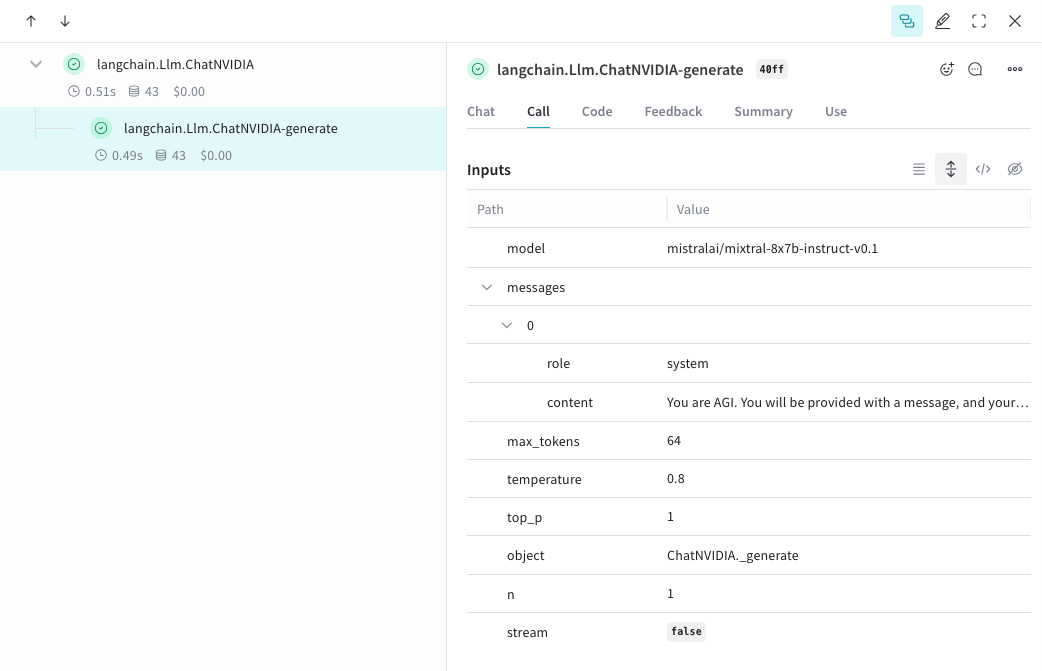
After you run this code, Weave captures the ChatNVIDIA call under the project name you specified, where you can inspect the inputs, outputs, and metadata.
```plaintext theme={null}
This feature is not available in TypeScript yet since this library is only in Python.
```
 ## Track your own ops
Wrapping a function with `@weave.op` starts capturing inputs, outputs, and app logic so you can debug how data flows through your app. You can deeply nest ops and build a tree of functions that you want to track. This also starts automatic code versioning as you experiment to capture ad-hoc details that you haven't committed to Git.
Create a function decorated with [`@weave.op`](/weave/guides/tracking/ops) that calls into [ChatNVIDIA Python library](https://python.langchain.com/docs/integrations/chat/nvidia_ai_endpoints/).
In the following example, two functions are wrapped with op. This shows you how intermediate steps, like the retrieval step in a RAG app, affect how your app behaves.
```python lines {1,9,11,29,31,33} theme={null}
import weave
from langchain_nvidia_ai_endpoints import ChatNVIDIA
import requests, random
PROMPT="""Emulate the Pokedex from early Pokémon episodes. State the name of the Pokemon and then describe it.
Your tone is informative yet sassy, blending factual details with a touch of dry humor. Be concise, no more than 3 sentences. """
POKEMON = ['pikachu', 'charmander', 'squirtle', 'bulbasaur', 'jigglypuff', 'meowth', 'eevee']
client = ChatNVIDIA(model="mistralai/mixtral-8x7b-instruct-v0.1", temperature=0.7, max_tokens=100, top_p=1)
@weave.op
def get_pokemon_data(pokemon_name):
# This is a step within your application, like the retrieval step within a RAG app
url = f"https://pokeapi.co/api/v2/pokemon/{pokemon_name}"
response = requests.get(url)
if response.status_code == 200:
data = response.json()
name = data["name"]
types = [t["type"]["name"] for t in data["types"]]
species_url = data["species"]["url"]
species_response = requests.get(species_url)
evolved_from = "Unknown"
if species_response.status_code == 200:
species_data = species_response.json()
if species_data["evolves_from_species"]:
evolved_from = species_data["evolves_from_species"]["name"]
return {"name": name, "types": types, "evolved_from": evolved_from}
else:
return None
@weave.op
def pokedex(name: str, prompt: str) -> str:
# This is your root op that calls out to other ops
data = get_pokemon_data(name)
if not data: return "Error: Unable to fetch data"
messages=[
{"role": "system","content": prompt},
{"role": "user", "content": str(data)}
]
response = client.invoke(messages)
return response.content
weave.init('pokedex-nvidia')
# Get data for a specific Pokémon
pokemon_data = pokedex(random.choice(POKEMON), PROMPT)
```
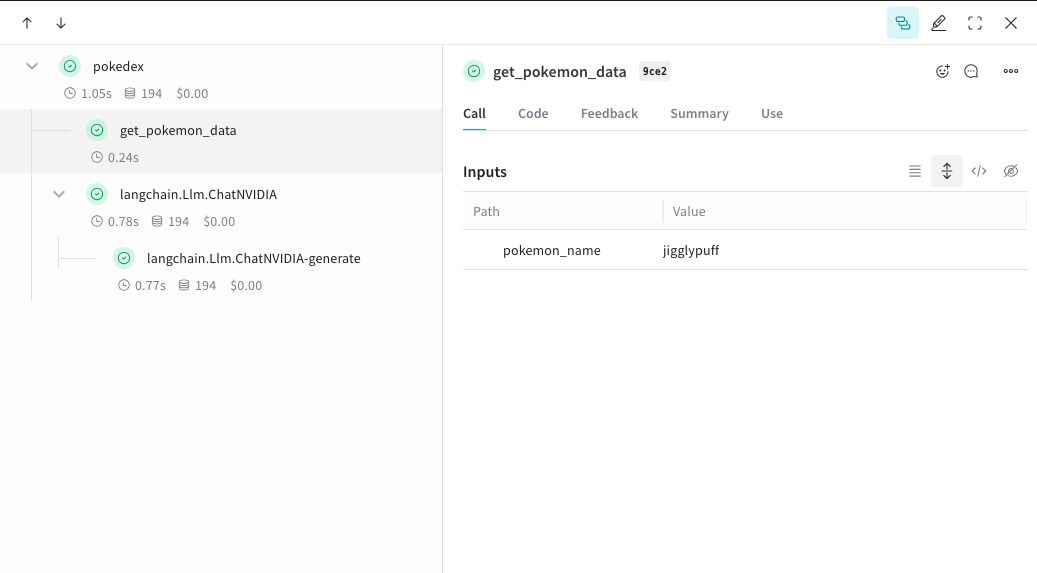
Navigate to Weave and click `get_pokemon_data` in the UI to see the inputs and outputs of that step.
```plaintext theme={null}
This feature is not available in TypeScript yet since this library is only in Python.
```
## Track your own ops
Wrapping a function with `@weave.op` starts capturing inputs, outputs, and app logic so you can debug how data flows through your app. You can deeply nest ops and build a tree of functions that you want to track. This also starts automatic code versioning as you experiment to capture ad-hoc details that you haven't committed to Git.
Create a function decorated with [`@weave.op`](/weave/guides/tracking/ops) that calls into [ChatNVIDIA Python library](https://python.langchain.com/docs/integrations/chat/nvidia_ai_endpoints/).
In the following example, two functions are wrapped with op. This shows you how intermediate steps, like the retrieval step in a RAG app, affect how your app behaves.
```python lines {1,9,11,29,31,33} theme={null}
import weave
from langchain_nvidia_ai_endpoints import ChatNVIDIA
import requests, random
PROMPT="""Emulate the Pokedex from early Pokémon episodes. State the name of the Pokemon and then describe it.
Your tone is informative yet sassy, blending factual details with a touch of dry humor. Be concise, no more than 3 sentences. """
POKEMON = ['pikachu', 'charmander', 'squirtle', 'bulbasaur', 'jigglypuff', 'meowth', 'eevee']
client = ChatNVIDIA(model="mistralai/mixtral-8x7b-instruct-v0.1", temperature=0.7, max_tokens=100, top_p=1)
@weave.op
def get_pokemon_data(pokemon_name):
# This is a step within your application, like the retrieval step within a RAG app
url = f"https://pokeapi.co/api/v2/pokemon/{pokemon_name}"
response = requests.get(url)
if response.status_code == 200:
data = response.json()
name = data["name"]
types = [t["type"]["name"] for t in data["types"]]
species_url = data["species"]["url"]
species_response = requests.get(species_url)
evolved_from = "Unknown"
if species_response.status_code == 200:
species_data = species_response.json()
if species_data["evolves_from_species"]:
evolved_from = species_data["evolves_from_species"]["name"]
return {"name": name, "types": types, "evolved_from": evolved_from}
else:
return None
@weave.op
def pokedex(name: str, prompt: str) -> str:
# This is your root op that calls out to other ops
data = get_pokemon_data(name)
if not data: return "Error: Unable to fetch data"
messages=[
{"role": "system","content": prompt},
{"role": "user", "content": str(data)}
]
response = client.invoke(messages)
return response.content
weave.init('pokedex-nvidia')
# Get data for a specific Pokémon
pokemon_data = pokedex(random.choice(POKEMON), PROMPT)
```
Navigate to Weave and click `get_pokemon_data` in the UI to see the inputs and outputs of that step.
```plaintext theme={null}
This feature is not available in TypeScript yet since this library is only in Python.
```
 ## Create a `Model` for easier experimentation
Organizing experimentation is difficult when there are many moving pieces. By using the [`Model`](/weave/guides/core-types/models) class, you can capture and organize the experimental details of your app like your system prompt or the model you're using. This helps you organize and compare different iterations of your app.
In addition to versioning code and capturing inputs and outputs, [`Model`](/weave/guides/core-types/models)s capture structured parameters that control your application's behavior, making it straightforward to find what parameters worked best. You can also use Weave Models with `serve`, and [`Evaluation`](/weave/guides/core-types/evaluations)s.
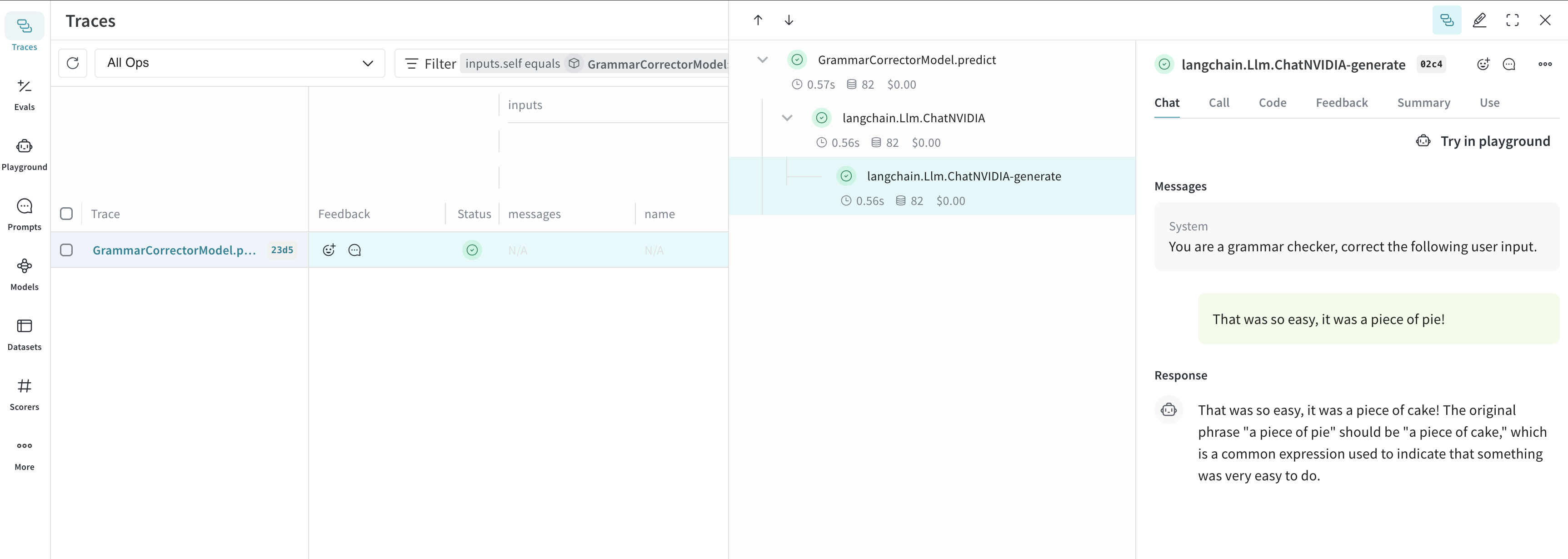
In the following example, you can experiment with `model` and `system_message`. Every time you change one of these, you get a new *version* of `GrammarCorrectorModel`.
```python lines theme={null}
import weave
from langchain_nvidia_ai_endpoints import ChatNVIDIA
weave.init('grammar-nvidia')
class GrammarCorrectorModel(weave.Model): # Change to `weave.Model`
system_message: str
@weave.op()
def predict(self, user_input): # Change to `predict`
client = ChatNVIDIA(model="mistralai/mixtral-8x7b-instruct-v0.1", temperature=0, max_tokens=100, top_p=1)
messages=[
{
"role": "system",
"content": self.system_message
},
{
"role": "user",
"content": user_input
}
]
response = client.invoke(messages)
return response.content
corrector = GrammarCorrectorModel(
system_message = "You are a grammar checker, correct the following user input.")
result = corrector.predict("That was so easy, it was a piece of pie!")
print(result)
```
```plaintext theme={null}
This feature is not available in TypeScript yet since this library is only in Python.
```
## Create a `Model` for easier experimentation
Organizing experimentation is difficult when there are many moving pieces. By using the [`Model`](/weave/guides/core-types/models) class, you can capture and organize the experimental details of your app like your system prompt or the model you're using. This helps you organize and compare different iterations of your app.
In addition to versioning code and capturing inputs and outputs, [`Model`](/weave/guides/core-types/models)s capture structured parameters that control your application's behavior, making it straightforward to find what parameters worked best. You can also use Weave Models with `serve`, and [`Evaluation`](/weave/guides/core-types/evaluations)s.
In the following example, you can experiment with `model` and `system_message`. Every time you change one of these, you get a new *version* of `GrammarCorrectorModel`.
```python lines theme={null}
import weave
from langchain_nvidia_ai_endpoints import ChatNVIDIA
weave.init('grammar-nvidia')
class GrammarCorrectorModel(weave.Model): # Change to `weave.Model`
system_message: str
@weave.op()
def predict(self, user_input): # Change to `predict`
client = ChatNVIDIA(model="mistralai/mixtral-8x7b-instruct-v0.1", temperature=0, max_tokens=100, top_p=1)
messages=[
{
"role": "system",
"content": self.system_message
},
{
"role": "user",
"content": user_input
}
]
response = client.invoke(messages)
return response.content
corrector = GrammarCorrectorModel(
system_message = "You are a grammar checker, correct the following user input.")
result = corrector.predict("That was so easy, it was a piece of pie!")
print(result)
```
```plaintext theme={null}
This feature is not available in TypeScript yet since this library is only in Python.
```
 ## Usage info
The following notes describe what the ChatNVIDIA integration supports.
The ChatNVIDIA integration supports `invoke`, `stream`, and their async variants. It also supports tool use.
Because ChatNVIDIA is meant for use with many types of models, it doesn't have function calling support.
## Usage info
The following notes describe what the ChatNVIDIA integration supports.
The ChatNVIDIA integration supports `invoke`, `stream`, and their async variants. It also supports tool use.
Because ChatNVIDIA is meant for use with many types of models, it doesn't have function calling support.